


Frizzy hair after every wash? It might be your towel.
- Flat-woven, so there are no loops to rough up wet hair
- Light on your head, and it stays put while you get ready
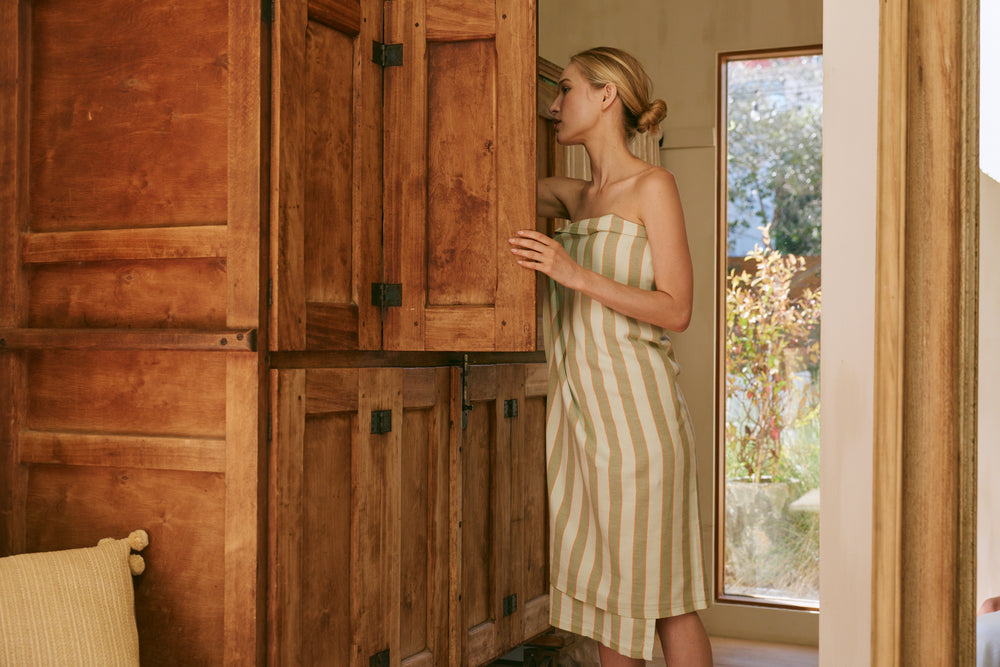
- One towel for your hair and the rest of you: 38″ × 71″
Three things a terry towel does to wet hair
Why hair gets frizzy after a shower.
Every strand of hair is covered in tiny overlapping scales, like roof shingles. When they lie flat, hair looks smooth. When they lift, moisture gets in, the strand swells, and you get frizz.
Wet hair is at its most fragile, and a terry towel is covered in thousands of little loops. That's a lot of friction at exactly the wrong moment. Humidity and your hair type play a part too, but the towel is the easy one to change.
It's woven flat, with no loops to catch your hair. Drying wet hair with terry is like using velcro. A peshtemal is more like a bedsheet. Less friction, less frizz.
Terry towels are HEAVY
A thick terry towel is heavy before it touches water. Wrapped around wet hair it gets heavier, and all of that weight hangs from your hairline and your neck while you get ready.
It's one thin layer of cotton, so there's far less to carry. It sits light on your head, without pulling.

No more holding your towel on with one hand.
You twist it up, lean over the sink, and it slides off. So you hold it on with one hand, or give up and let your hair air dry. It isn't how you wrap it. A thick towel is too bulky to tuck and too heavy to stay.
At 38″ × 71″ it's long enough to wrap a few times, and thin enough to twist and tuck. It stays put through skincare, makeup and getting dressed.


MEET THE PESHTEMAL

The towel from the Turkish hammam.
It comes from the hammam, the Turkish bathhouse, where it's still the towel you're handed after the steam. People have been weaving them for centuries.
It's flat-woven from 100% long-fiber Turkish cotton, with no loops. That's why it's light, big, quick to dry and gentle on hair. It gets softer with every wash.
In the US you've probably seen it sold as a “Turkish towel” for the beach. We think it belongs in your bathroom.
It's thinner than what you're used to, and it takes most people a few days to get used to it. If thick and fluffy is non-negotiable, we're probably not your towel, and that's okay.
One flat layer. No loops.
A peshtemal is cotton yarn woven flat, over and under, into a single thin layer. That's the whole towel.
The towel most of us grew up with adds thousands of small loops to that flat cloth, on both sides. Weavers in Bursa are said to have started it a few hundred years ago. In 1850 a factory near Manchester began making it by machine, and it became the towel in most bathrooms.
Both are Turkish. The peshtemal came first.
“It's so thin. Will it actually dry me?”
Yes. How well a towel dries you comes from the cotton, not the thickness. Ours is 100% long-fiber Turkish cotton, flat-woven, so it takes the water off you and then lets it go on the hook instead of holding on to it.
It gets even more absorbent after a wash or two, and keeps getting better from there.
A thick towel feels like it's doing more because it holds more water. That's also why it's still wet hours later. A peshtemal dries you, then dries itself.
In a flat towel, the yarn is the towel
A looped towel hides its yarn in the pile. A peshtemal is one flat layer, so there's nothing to hide behind.
It lasts for years
A thin cloth is only as good as its yarn. Strong, even yarn is what lets a peshtemal be light and still hold up.
Easy on skin and hair
Fewer loose ends means less fuzz, less lint and less to catch on your hair.
Softer with every wash
Long, combed fibers stay in the yarn, so the cloth softens with washing where a cheaper yarn goes rough.
Built to last for years, not one season.
A $10 towel feels like a deal until it goes rough, frays or starts to smell, and you buy another one. Ours is 100% long-fiber Turkish cotton that gets softer with every wash. Customers who bought one years ago are still using it.
Bought my first Wetcat 5 years ago and they still look brand new. — Suzanne A., verified buyer
$39 ÷ 8 years ≈ 1.3¢ a day
Based on daily use. The $10 towel gets replaced every year. Ours doesn't.
How we stack up
Same idea, better made. Tap a comparison to see how Wetcat is different.
 Fringeless Turkish towels
Fringeless Turkish towels
Shop our best-sellers
Spend $130 and we'll add a hand towel set, free.


From people who made the switch
The more you wash, the softer they get.
Verified buyerLove no fringe and lightweight and fast dry.
Verified buyerPlus size / extra long / wide is ALWAYS needed and appreciated.
Verified buyerOVER 750,000 MADE THE SWITCH
People love Wetcat — read why 98% of Wetcat customers would shop with us again.

Made by a Turkish brother and sister
We're Ugur and Bediz, a brother and sister born and raised in Türkiye. We started Wetcat to share the peshtemal, the towel of the Turkish hammam, and we still make everything in small batches back home.
“Did you copy a big American brand?”
Nobody invented Turkish towels; they've been woven in Türkiye for centuries. We grew up with the real thing, and Wetcat is how we share it.
Ugur & Bediz
Before you switch
Will it help with frizzy hair?
It's gentle on wet hair. The flat weave glides instead of grabbing, so there's less friction, and less frizz. Frizz has other causes too, like humidity, heat and your hair type, so we won't promise it disappears.
How do I wrap my hair in it?
Fold it twice, wrap it around your head and tuck the end in. It's light, so it stays put without pulling. Press and squeeze your hair with it instead of rubbing.
I already use a T-shirt or a microfiber hair towel. Why switch?
If that works for you, keep it. They help for the same reason: no loops rubbing against wet hair. A peshtemal does that too, and it's also your bath towel, so it's one towel for your hair and the rest of you.
Does it actually absorb water? It looks so thin.
Yes. It's very absorbent, and it gets even better after a wash or two. How well a towel dries you comes from the cotton, not the thickness.
Why does it cost more than a regular towel?
It's 100% long-fiber Turkish cotton, woven in Türkiye, and it's built to last for years. It gets softer with every wash instead of going rough, so you're not replacing it every year.
Isn't this a beach towel?
That's how it's usually sold here. It started in the hammam, as a towel for after bathing, and that's how we make it: to be your everyday bath towel.
Where is it made?
In Türkiye. Our peshtemals are woven there in small batches, and our team there checks, labels, folds and packs every one before it ships to the US.
Are there any harmful chemicals in it?
Every Wetcat towel is OEKO-TEX® STANDARD 100 certified, in product class I, the class made for babies. That means it's been independently tested for harmful substances. Our number is 23.HTR.34986; you can enter it at oeko-tex.com/label-check.
How big is it?
38″ × 71″, about the size of a bath sheet. Big enough to tuck and let go.
Where do you ship from?
From our warehouse in Charleston, South Carolina. Shipping is free on orders over $100, and $4.95 under that.
How do I care for it?
Wash it when it's dirty, not when it smells. Skip the fabric softener (it coats the cotton). Hang it spread out so it dries fast.